
Genealogy System
The Problem
The client, an avid genealogist maintaining a family tree of over 1,200 people, faced a frustrating landscape of existing solutions. Commercial platforms like Ancestry and MyHeritage came with steep subscription costs that scaled with usage. Open-source alternatives such as Gramps Web offered data ownership but suffered from dated, unintuitive interfaces that made everyday tasks tedious. Most critically, merging data between family trees — a core need when collaborating with relatives — was an all-or-nothing operation across existing tools, leading to duplicate records, data loss, and hours of manual cleanup. The client needed a tool that was affordable, pleasant to use, and smart about combining family research from multiple contributors.
Our Approach
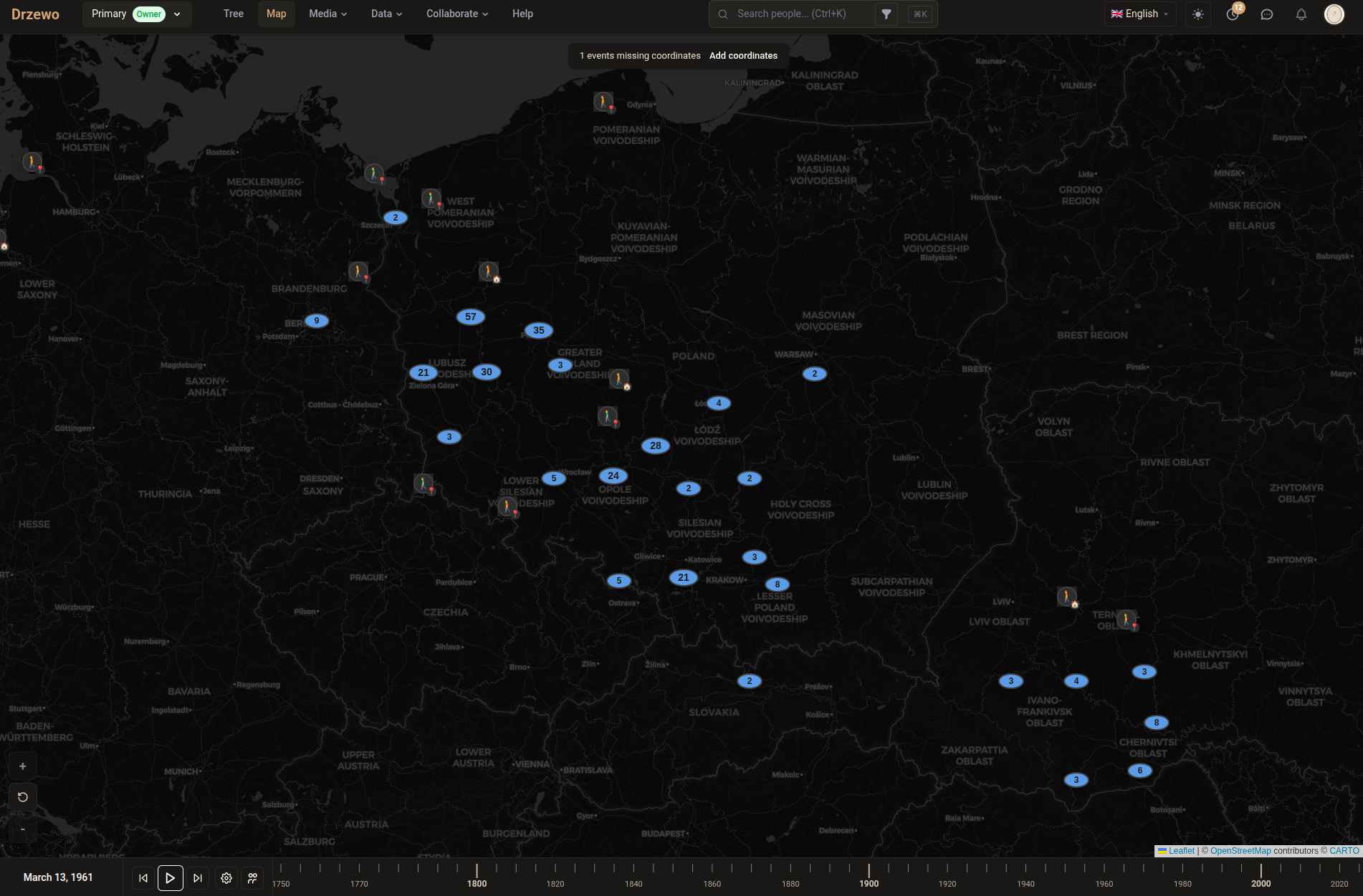
We built Drzewo from the ground up on the Golem15 Stack (WinterCMS/Laravel backend, Vue 3 + TypeScript frontend) with real-time collaboration at its core. An interactive D3-powered tree visualization replaced static page-based navigation. We implemented a selective merge system with field-by-field comparison, full provenance tracking, and one-click rollback — solving the tree merge problem entirely. Privacy was designed in from day one: trees are private by default, cross-tree matching uses phonetic algorithms with mutual consent workflows, and face recognition runs on a self-hosted CompreFace instance requiring explicit GDPR consent. The platform supports full GEDCOM 5.5.1 and Gramps SQLite import/export to ensure zero vendor lock-in. A freemium model with Stripe integration keeps the platform sustainable without the aggressive pricing of commercial alternatives.
The Outcome
The client successfully migrated their entire 1,239-person family tree from Gramps with full data fidelity. Family members now collaborate in real time — seeing each other's cursors, chatting in-tree, and receiving live activity feeds. The selective merge system has eliminated the fear of combining trees: contributors can safely share and cherry-pick records field by field, with every change tracked and reversible. AI face recognition has accelerated photo tagging across hundreds of historical family photos. The platform serves as a production-ready SaaS with a generous free tier (1 tree, 250 people), making genealogy accessible without the prohibitive costs that initially drove the project.